Largest Rectangle in Histogram
Problem Type: Monotonic Stack
Related Problems:
Problem
Given an array of integers heights representing the histogram's bar height where the width of each bar is 1, return the area of the largest rectangle in the histogram.
1 <= heights.length <= 10⁵0 <= heights[i] <= 10⁴
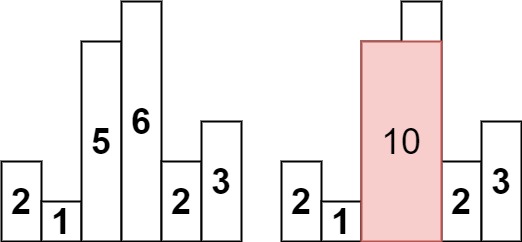
Input: heights = [2, 1, 5, 6, 2, 3]
Output: 10
Explanation: The largest rectangle is shown in the red area, which has an area of 10 units.
Input: heights = [2, 4]
Output: 4
Explanation: The largest rectangle is shown in the red area, which has an area of 4 units.

Solution
Whether using brute force or monotonic stack, the idea is to take a specific height, for example heights[2] (which is 5) in the first example, then expand in both directions to find the nearest bars that are shorter than it:
- Expand left:
heights[1]is less thanheights[2], meaning to maintain the height ofheights[2], the left boundary must be at index1 - Expand right:
heights[4]is less thanheights[2], meaning to maintain the height ofheights[2], the right boundary must be at index4
Thus, the maximum width maintaining the height heights[2] is 4 - 1 - 1 = 2.
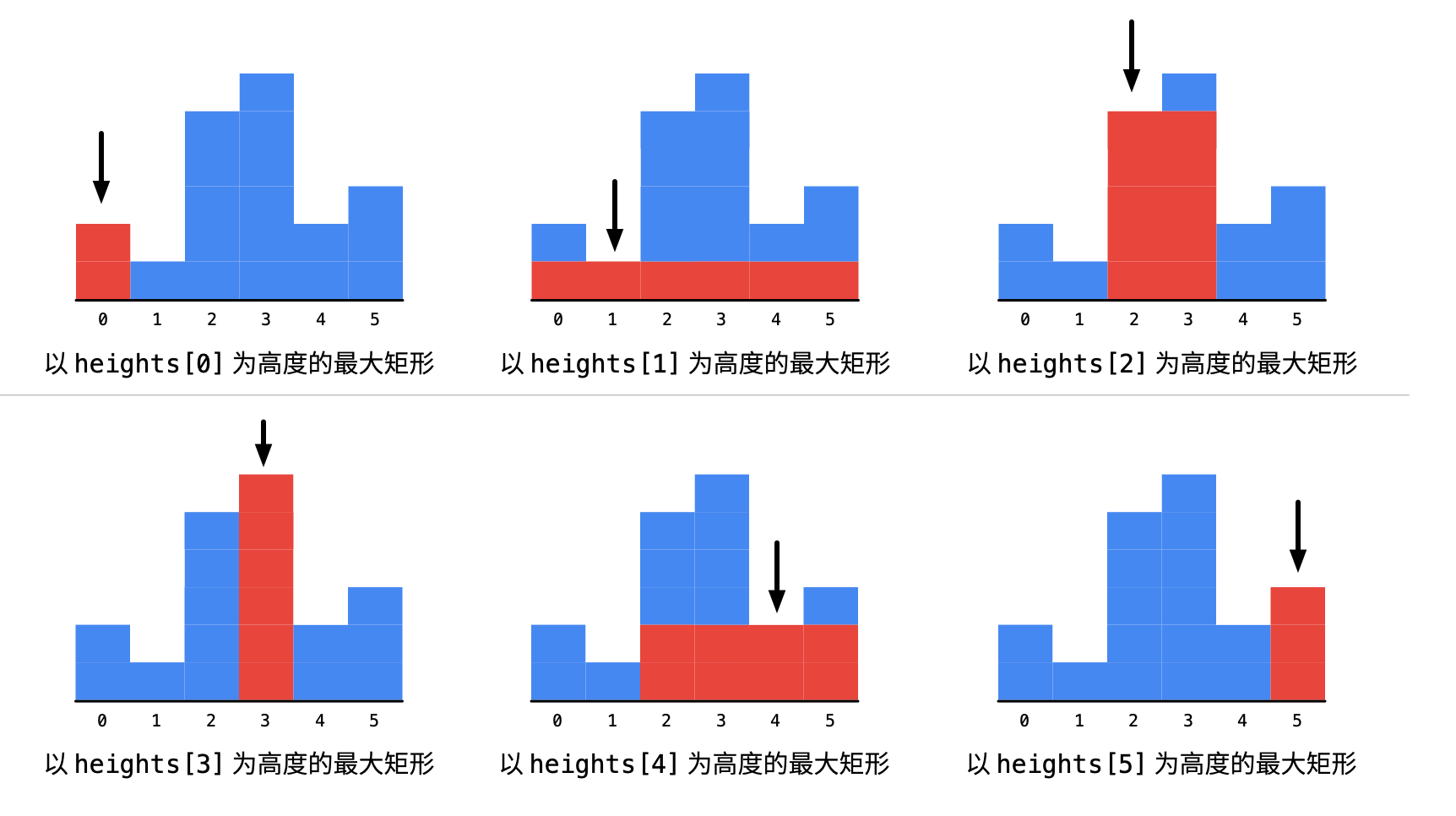
For the brute force approach, we need to iterate through each height, then use it as a pivot and expand left and right to find the left and right boundaries. However, this results in O(n²) time complexity. Therefore, we can use a space-for-time strategy with a monotonic stack to pre-calculate the left and right boundaries for each bar. See the code comments for the specific implementation.
- JavaScript - Brute Force
- JavaScript - Monotonic Stack
- Rust
/**
 * @param {number[]} heights
 * @return {number}
 */
var largestRectangleArea = function (heights) {
  const n = heights.length
  let max = 0

  for (let i = 0; i < n; i++) {
    const height = heights[i]

    let left = i
    while (left > 0 && heights[left - 1] >= height) {
      left--
    }

    let right = i
    while (right < n - 1 && heights[right + 1] >= height) {
      right++
    }

    max = Math.max(max, height * (right - left + 1))
  }

  return max
}
- Time Complexity:
O(n²) - Space Complexity:
O(1)
/**
 * @param {number[]} heights
 * @return {number}
 */
var largestRectangleArea = function (heights) {
  const n = heights.length

  // Find the left boundary (smaller than current element) for each bar
  // Default is -1: if all elements to the left are taller,
  // we can extend the current height all the way to the left, so the boundary is -1
  //
  // Note: We use -1 instead of 0 because we're storing indices
  const lefts = new Array(n).fill(-1)

  // Find the right boundary (smaller than current element) for each bar
  // Default is n: if all elements to the right are taller,
  // we can extend the current height all the way to the right, so the boundary is n
  const rights = new Array(n).fill(n)

  const stack = []

  // Standard monotonic stack: find the right boundary (smaller element) for each bar
  for (let i = 0; i < n; i++) {
    while (stack.length > 0 && heights[stack[stack.length - 1]] > heights[i]) {
      rights[stack.pop()] = i
    }

    stack.push(i)
  }

  // Standard monotonic stack: find the left boundary (smaller element) for each bar
  for (let i = n - 1; i >= 0; i--) {
    while (stack.length > 0 && heights[stack[stack.length - 1]] > heights[i]) {
      lefts[stack.pop()] = i
    }

    stack.push(i)
  }

  let max = 0

  // Calculate the maximum area using left/right boundaries and current bar height
  for (let i = 0; i < n; i++) {
    max = Math.max(max, (rights[i] - lefts[i] - 1) * heights[i])
  }

  return max
}
- Time Complexity:
O(n) - Space Complexity:
O(n)
use std::cmp;

pub fn largest_rectangle_area(heights: Vec<i32>) -> i32 {
    let n = heights.len();
    let mut left: Vec<isize> = vec![-1; n];
    let mut right = vec![n; n];
    let mut stack = vec![];

    for i in 0..n {
        while !stack.is_empty() && heights[stack[stack.len() - 1]] > heights[i] {
            right[stack.pop().unwrap()] = i;
        }

        stack.push(i);
    }

    for i in (0..n).rev() {
        while !stack.is_empty() && heights[stack[stack.len() - 1]] > heights[i] {
            left[stack.pop().unwrap()] = i as isize;
        }

        stack.push(i);
    }

    let mut max = 0;
    for i in 0..n {
        let height = heights[i];
        let left_idx = left[i];
        let right_idx = right[i];
        max = cmp::max(max, height * (right_idx as i32 - left_idx as i32 - 1));
    }

    max
}